Online presence · 11 min read · April 2026
Why Facebook or Instagram Alone Costs You Customers
Your business is on Facebook. You post on Instagram. Customers message you in DMs. And for a while, that feels like enough.
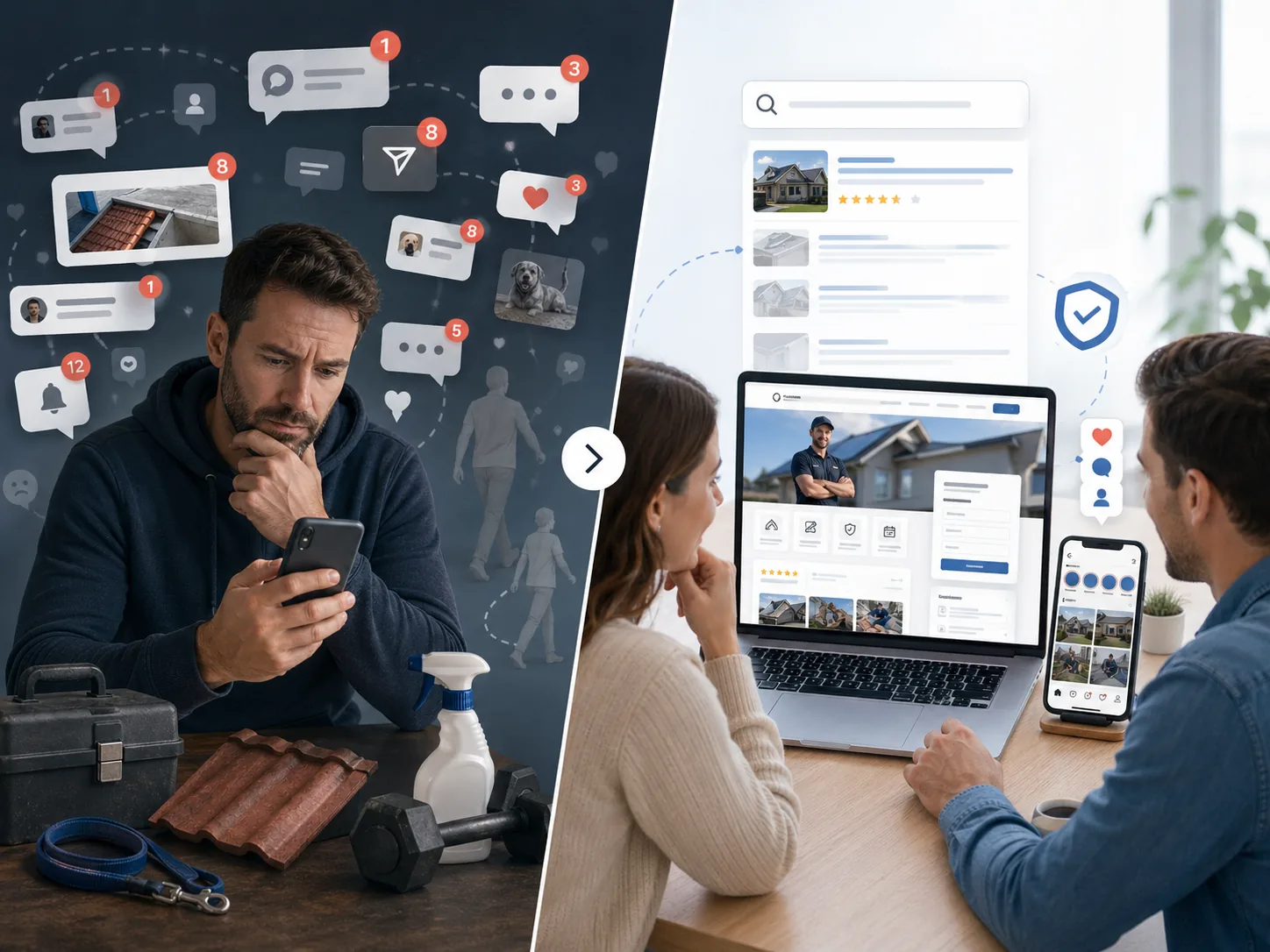
But if that’s all you rely on, you could be losing customers without even realising it, every single day.
This isn’t about abandoning social media. It’s about understanding a simple truth: Facebook and Instagram are tools for visibility. A website is your foundation. And without that foundation, every enquiry, every comparison, and every customer decision happens on someone else’s terms.
Here’s exactly why relying only on social media is costing your business, and what the smarter setup looks like.
Section 01
Your Customers Are Not Just on Social Media
When someone needs a roofer, a window cleaner, a personal trainer, or a bathroom fitter, many of them open Google and search. Not Instagram. Not Facebook. Google.
They type something like “window cleaner near me” or “bathroom fitter [town]” and look at the results. If your business only exists properly on a social profile, you may not appear at all, or you may appear too informally to be taken seriously by someone who has never heard of you.
Customers also compare before they commit. They look at two or three local businesses before deciding who to contact. That comparison takes seconds, and the business that looks clearest and most professional usually wins.
If customers can’t find clear information quickly, they move on. Not to your DMs, to your competitor’s website.
Section 02
You Don’t Control Social Platforms
Every hour you spend building your Facebook page or Instagram profile is time invested in a platform you don’t own. And that comes with real, ongoing risk most business owners don’t think about until something goes wrong.
- Algorithms change without warning, posts that used to reach hundreds of people now reach a fraction, for no reason you can control
- Accounts can be restricted, hacked, suspended, or permanently deleted, with little to no warning and very limited recourse
- Posts disappear from feeds within hours, what you shared last week is effectively invisible to most people today
- Your content, your followers, and your business history all sit on someone else’s platform, subject to their rules and decisions
Social media is rented space. Your website is your property, and nobody can take it from you.
Section 03
Social Profiles Make Customers Work Too Hard
Think about what a new customer has to do to find basic information on your Facebook page or Instagram profile. They scroll through posts trying to spot a price. They dig through story highlights looking for services. They check your bio to guess what area you cover.
That’s too much effort, and customers don’t put in that effort. If your business looks harder to understand than the next one, they choose the next one.
What customers have to dig for on social profiles
- What services you actually offer
- Which areas you cover
- Pricing or starting prices
- Availability or how to book
- Examples of your past work
- Reviews or trust signals
- Your contact details
- Whether you’re even still trading
A well-structured website puts all of that on a single clear page, and customers can find what they need in seconds. No scrolling. No guessing. No friction.
If your business looks harder to understand, customers will choose someone easier.
Section 04
DMs Are Not a Reliable Enquiry System
Many service businesses rely on Instagram DMs or Facebook Messenger as their main enquiry channel. And while it occasionally works, the cracks appear fast, and they cost you real money.
- Enquiries arrive across Instagram, Facebook, WhatsApp, missed calls, and comments, scattered, untracked, and easy to miss
- Customers send incomplete messages with no location, no service detail, no timeframe, meaning every reply starts a guessing game
- You waste time asking the same follow-up questions before you can even consider quoting, let alone winning the work
- Messages get buried or overlooked, and the customer assumes you’re not interested and moves on to whoever responds first
When your enquiry process is disorganised, good leads slip through the cracks, and you may never even know it happened.
A structured enquiry form on your website collects the details you actually need, upfront, every time, so you can respond quickly and quote with confidence.
Section 05
Why a Website Builds More Trust
Customers are careful with who they trust, especially for work on their home, their garden, or involving their family. A professional website gives people the confidence they need to pick up the phone or fill in an enquiry form.
People feel safer choosing businesses that look established. A website with clear services, verified reviews, and photos of real work communicates credibility in a way a social profile simply cannot replicate.
- A roofer can show project photos, emergency cover services, insurance details, and clear coverage areas
- A dog walker can display service areas, first aid qualifications, safety information, and daily schedule options
- A personal trainer can showcase packages, client testimonials, qualifications, and a simple booking option
- A bathroom fitter can feature before-and-after galleries, a clear process, accreditations, and a quote form
Your skill wins the job. Your online presence wins you the chance to do it.
Section 06
The Better Setup: Website, Google, and Social, Together
The most effective approach isn’t one or the other, it’s all three, each doing the job it’s actually built for. Here’s how they work together:
-
Website
Your foundation, services, trust signals, enquiry form, and contact details
-
Google
How new customers discover you through local search, your website makes this possible
-
Social media
Proof of your work, personality, and updates, sends interested people to your site
-
Enquiry form
Where attention turns into a real, structured lead that you can act on
| Factor | Social media only | Website + social |
|---|---|---|
| Finding information | Customers dig through posts | Clear service pages, all in one place |
| Enquiry quality | DMs with missing details | Structured form with everything you need |
| Trust signals | Followers and post likes | Reviews, photos, services, and credentials |
| Discoverability | Only within the platform | Google search + social media combined |
| Your control | Platform rules everything | You own your website and its content |
| Professionalism | Depends on posting consistency | Consistent, clear, and always available |
Section 07
Before vs After
The difference between a business relying only on social media and one with a proper website isn’t just about where you appear online, it’s about how customers experience you, and how many of them actually get in touch.
Social media only
- Hard to find pricing or service details
- Customers scroll through posts to piece things together
- DMs with missing information and back-and-forth
- Limited trust, no reviews or credentials in one place
- Invisible to Google search
- Platform changes can wipe out your presence overnight
Website + social media
- Clear structure, services, pricing, and contact in one place
- Customers arrive already informed and ready to enquire
- Structured form that collects the details you actually need
- Reviews, photos, and credentials build trust instantly
- Visible in Google when customers are actively searching
- Your business is yours, no algorithm can take it away
Section 08
What Your Business Should Have
You don’t need anything complicated. A well-built website for a service business is straightforward, but it needs to cover the right ground to do its job properly.
-
Website homepage
A clear headline, what you do, and an immediate way to contact you. Customers should know within five seconds if they’re in the right place.
-
Service pages
Each service explained clearly, what’s included, who it’s for, and where you work. No guessing, no back-and-forth.
-
Contact or enquiry form
Structured, simple, and placed prominently. Collects the details you need so every enquiry arrives with context.
-
Reviews or testimonials
Real customer feedback displayed on your website. One of the strongest trust signals you can have, especially for new customers.
-
Clear calls-to-action
Every page should tell the visitor what to do next, “Get a quote”, “Request a callback”, “View services”. Don’t make them guess.
-
Mobile-friendly design
The majority of local searches happen on a phone. If your site doesn’t work perfectly on mobile, you’re losing enquiries before they start.
-
Simple navigation
Customers should be able to find what they need in two clicks or fewer. Complex menus and buried information cost you bookings.
Not sure where to start? Get in touch and we’ll walk you through what your business actually needs.
Frequently Asked Questions
- Is Facebook or Instagram enough for a business?
- Not on its own. Social media is useful for visibility and showing your work, but it doesn’t rank well in Google search, gives customers no structured place to find your services and pricing, and can be taken from you at any time. A website gives you a professional home that you own and control.
- Do I still need a website if I use social media?
- Yes. Most customers searching for local services use Google, not Facebook or Instagram. Without a website, you’re invisible to those searches. A website also builds trust faster, handles enquiries more efficiently, and isn’t subject to algorithm changes or platform restrictions.
- Why do customers trust websites more than social profiles?
- A website signals that you’re an established, serious business. It gives customers a structured place to see your services, read reviews, view your work, and find your contact details, all in one place. Social profiles require customers to piece that picture together themselves, which most won’t bother doing.
- Can a website help me get more enquiries?
- Significantly. A website with a clear enquiry form removes every barrier between an interested customer and a booked job. It also works around the clock, capturing leads while you’re on a job, asleep, or off for the weekend, in a way that social media DMs simply can’t match.
- What should a service business website include?
- At minimum: a clear homepage, service pages, customer reviews, a contact or enquiry form, clear calls-to-action, and a mobile-friendly design. Simple navigation is equally important—customers should find what they need in two clicks or fewer. Speed and Google-readiness are also essential if you want to appear in local search results.