Productivity · 12 min read · April 2026
Stop Wasting Time Handling Customer Enquiries
You’re on a job. Your phone’s in your pocket. By the time you check it, you’ve got missed calls, half-written messages, and someone asking “how much?” with no details about what they need or where they are.
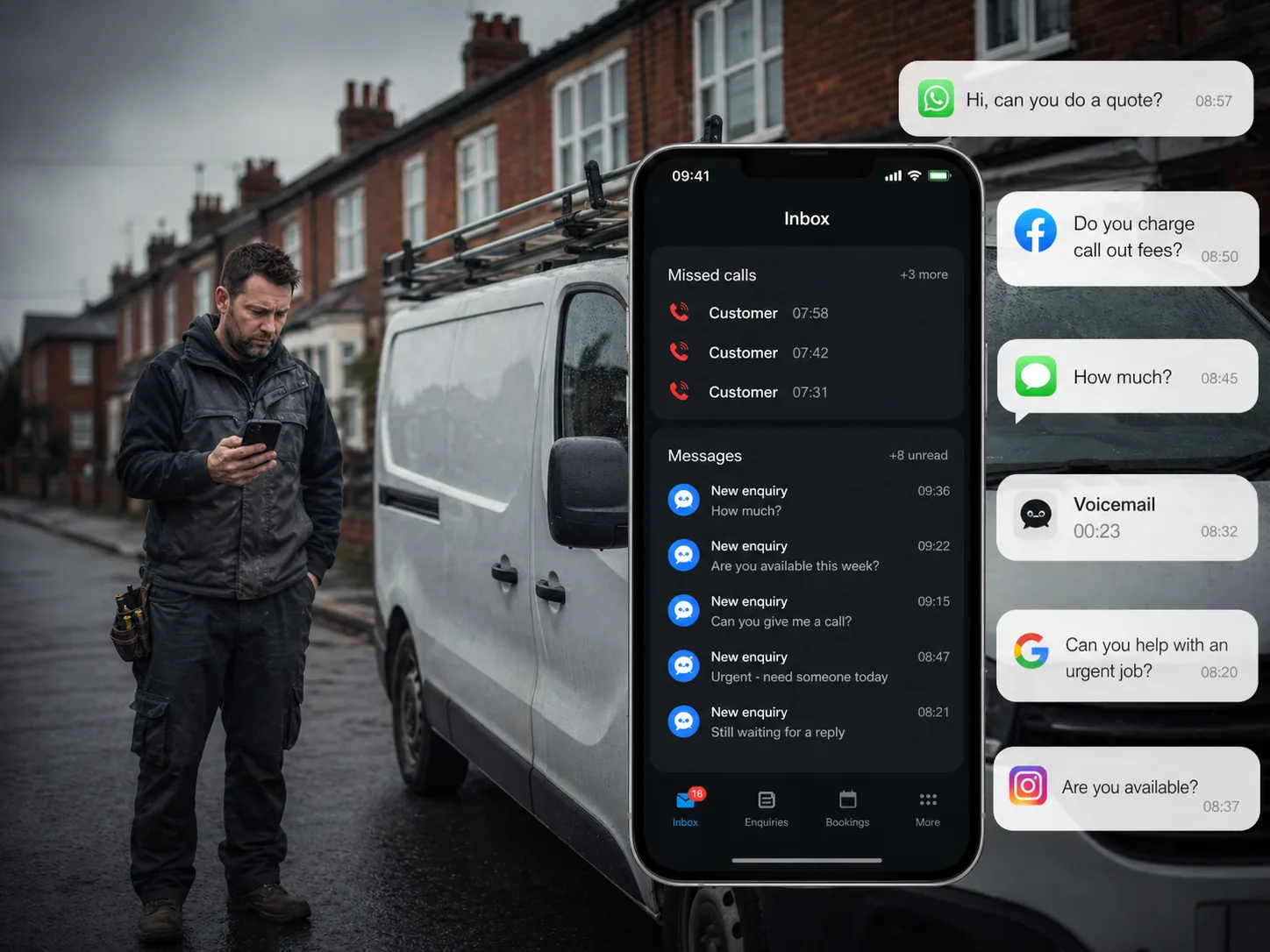
You reply when you can, but by then it’s too late. They’ve moved on to someone who got back to them faster. Maybe that was your competitor. Maybe it was just the next result on Google. Either way, you lost the job before you even knew you were in the running.
And then you do it all over again tomorrow. Same messages. Same questions. Same chaos. Five platforms, no structure, and never enough hours in the day.
This isn’t just frustrating, it’s costing you real customers.
Section 01
The Problem With Manual Enquiries
Most service businesses are juggling enquiries across four or five different places at once: WhatsApp, Facebook Messenger, Instagram DMs, missed calls, and voicemails. None of it is organised. None of it is consistent.
And even when someone does get through to you, the conversation takes forever. They ask what you offer. You explain. They ask about price. You explain again. They ask about availability. More back-and-forth. By the time you have the basic details, ten minutes have gone, for an enquiry that might not even convert.
- Messages scattered across Instagram, Facebook, WhatsApp, and voicemail, with no central record of any of it
- Enquiries missing basic details: no location, no service required, no timeframe, just a vague question
- Back-and-forth conversations just to collect the information you need to give a quote
- Hours of admin every week that adds no value to your actual business
Every missed message is a missed opportunity. And right now, they’re adding up.
Section 02
The Hidden Cost of a Disorganised System
Here’s the part most business owners don’t want to think about. Every missed call is a missed job. Every slow reply is a customer quietly choosing someone else. Every disorganised inbox is revenue slipping through the cracks.
Customers don’t wait, especially for smaller jobs. A window clean, a garden tidy, a bathroom quote. If they message three local businesses and you’re the slowest to respond, you’re out of the running before you even knew you were in it.
-
Missed calls
Lost jobs, they called someone else and booked immediately
-
Slow replies
Customers choose whoever responds first, every time
-
No system
No consistency, no follow-up, no record of who enquired
If you’re not easy to contact, you’re easy to replace.
Section 03
Why Your Current System Doesn’t Work
Instagram DMs, Facebook messages, WhatsApp chats, and phone calls, these tools were never designed to run a business enquiry process. They’re personal communication tools, and using them as your primary booking system creates problems that compound over time.
Here’s why each one falls short:
- Instagram DMs, easily missed, no notification priority, and customers can’t find basic service information before messaging
- Facebook messages, declining reach, ageing audience, and an inbox most businesses check less and less frequently
- WhatsApp, fine for existing customers, but not a structured enquiry channel; no record, no follow-up system
- Phone calls, impossible to take when you’re on a job, and voicemails often go unheard or unanswered for days
None of these platforms collect the information you actually need. None of them scale. And none of them make you look like the professional business you are.
See how Facebook and Instagram could be costing you customers right now.
Section 04
The Daily Time Drain
Think about how much time you spend every week just handling enquiries. Answering the same questions. Explaining your services. Quoting the same price range. Trying to figure out what someone actually needs from a two-word message.
For most service businesses, that’s easily five to ten hours a week, time you could spend on the tools, with your customers, or actually growing your business.
Questions you answer on repeat, every single week
- What areas do you cover?
- How much does it cost?
- Are you available this week?
- What’s included in the price?
- How long does it take?
- Do you have insurance?
You didn’t start your business to spend your day replying to messages. You started it to do the work, and do it well.
Section 05
What Customers Actually Want
Here’s what most business owners miss: customers aren’t being difficult when they send vague messages. They’re just looking for the path of least resistance. They want information quickly, and if your online presence doesn’t provide it, they’ll either ask, or they’ll move on.
What a potential customer actually wants when they first reach out:
- Quick, clear answers, they don’t want to wait days for a response or chase you for basic information
- Honest pricing, at least a guide price upfront so they know whether you’re in their budget
- A simple way to enquire without having to track you down across five different platforms
- Confidence that you’re professional, experienced, and trustworthy before they hand over their money
The business that answers these four things clearly, without back-and-forth, is the business that gets the enquiry.
Section 06
The Better Way to Handle Enquiries
The fix isn’t complicated. It doesn’t require a call centre, a virtual assistant, or expensive software. It starts with having a professional website that does the heavy lifting for you.
Instead of every customer kicking off with a vague “how much?” message, your website gives them what they need, and collects the details you need, before anyone picks up the phone.
- Customers fill in a proper enquiry form, including location, service type, and timeframe, before you’ve even seen the message
- Your services are explained clearly so people know exactly what they’re getting and whether you’re the right fit
- Common questions are answered on the page, no DMs needed just to find out what you charge
- Enquiry submissions arrive organised, with consistent information every time, no more guessing
- Everything works on mobile, because that’s where the majority of your customers are searching
No more guessing what someone needs. No more chasing incomplete messages. Just clear, structured enquiries that are quicker to action and far more likely to convert into paying work.
See why every service business needs a website to make this happen.
Section 07
How This Changes Your Business
When your enquiry process is working properly, everything else gets easier. You spend less time on your phone and more time on the work that actually earns you money.
-
Fewer interruptions
Stop fielding messages mid-job. Your website handles the initial questions and collects the details you need automatically.
-
Better quality enquiries
Customers who’ve read your site already know what you do and what it costs. They arrive warmer and more ready to book.
-
More organised workflow
All enquiries come through one place, with consistent information every time. No more hunting through five inboxes.
-
More bookings, less effort
A site that works 24/7 brings in enquiries while you sleep, while you’re on a job, and while you’re on the school run.
The businesses winning more local work aren’t necessarily better at their trade. They’re just easier to reach, easier to trust, and easier to hire. A proper enquiry system is how you become that business.
Section 08
Before vs After
The difference between a business that chases every message and one that has a structured enquiry system isn’t just time, it’s how professional you appear and how many customers actually follow through and book.
Before
- DMs arriving across five platforms
- Missed calls with no context
- Constant back-and-forth for basic details
- No record of who enquired or when
- Disorganised, reactive, and exhausting
After
- One structured enquiry system on your website
- Clear submissions with all the details you need
- Services and pricing explained upfront
- Customers arrive informed and ready to book
- More control, less chaos, more revenue
If your enquiries are messy, your business will feel messy to customers. Structure builds trust long before you ever speak to someone.
Section 09
What Your Enquiry System Should Include
Not every enquiry form is built equal. A form that actually reduces back-and-forth and brings in quality leads needs to collect the right information from the start. Here’s what to look for:
-
A contact form
The foundation of any enquiry system. Placed prominently on your website so customers can reach you without needing to find your number.
-
Service selection
Let customers tell you exactly what they need from a list of your services. Removes ambiguity and helps you prioritise and quote faster.
-
Location input
Collect the customer’s postcode or town upfront. Instantly tells you whether the job is within your coverage area, no follow-up needed.
-
Preferred date or timeframe
Knowing when someone needs the work done helps you manage your availability and respond with relevant options straight away.
-
A notes or details field
A free-text box where customers can describe their situation. Often the most useful part, gives you context you’d otherwise have to ask for.
-
A clear call-to-action
“Get a free quote” or “Request a callback” converts better than a generic “Submit” button.
-
Mobile-friendly design
The majority of local searches happen on a phone. If your form doesn’t work perfectly on mobile, you’re losing enquiries before they even start.
Need a hand getting this set up properly? Get in touch and we’ll walk you through exactly what your business needs.
Frequently Asked Questions
- How can I manage customer enquiries better?
- The most effective way is to move away from ad-hoc DMs and missed calls and towards a structured website enquiry form. When customers submit their details through a form, you receive organised, consistent information every time, which makes it far faster to respond and quote.
- Are Instagram and Facebook messages enough for a business?
- Not on their own. Social media inboxes are easy to miss, offer no structure, and don’t collect the information you actually need to act on an enquiry. They’re also platforms you don’t own—accounts can be restricted or shut down without warning.
- What is the best way to handle customer enquiries?
- A dedicated enquiry form on a professional website, combined with clear service information and upfront answers to common questions. This reduces back-and-forth, filters out time-wasters, and ensures every enquiry arrives with the context you need.
- Can a website reduce time spent replying to messages?
- Yes, significantly. When your website answers common questions upfront (services, pricing, coverage area, availability), customers arrive already informed. They’re not asking “how much?” because they already know the rough answer. That alone can save hours every week.
- What should an enquiry form include?
- At minimum: name, contact details, service required, location, preferred date or timeframe, and a notes field for additional context. A clear call-to-action and mobile-friendly design are equally important to ensure customers actually complete and submit the form.